Four Groups Blog


27/7/2005


Blending and Conceptual Integration

I’ve been doing some research on creativity and problem solving and have come across the idea of Blending. I think its a neat idea and one that possesses a great deal of power and application.

Blending is a concept which describes how we integrate, or blend, a number of different ideas into a single whole. The idea has roots in the study of language but it can be applied equally to many fields including creativity and problem solving. Originators of this work have include Turner (1996) and Fauconnier (1997) and their focus on CIN or a Conceptual Integration Network.
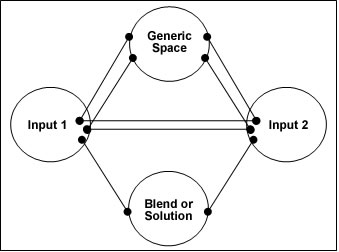
A simple diagram of Blending Theory

The diagram above outlines how, by combining generic space (or information) with two different inputs, a ‘blend’ or solution is created. One of the key ideas behind blending is the idea that while information is shared between the generic space and both of the inputs, it is the unique information that stems from the inputs that creates the specific solution. There are some further links and references below.

Links;
http://en.wikipedia.org/wiki/Talk:Conceptual_blending/Resources
http://www.humaniora.sdu.dk/~thewaywethink/encyclo.htm
http://markturner.org/blending.html

References;
Turner, Mark. 1996. “Creative Blends” and “Many Spaces.” Chapters 5 and 6 of The Literary Mind. New York: Oxford University Press.
Fauconnier, Gilles. 1997. “Blends.” Chapter 6 of Mappings in Thought and Language. New York: Cambridge University Press.

Share and Enjoy:

  • Reddit
  • Digg
  • email
  • Facebook
  • Print
  • LinkedIn
  • Twitter
Comments (3)

Filed under:
  • Psychology
By Bruce Lewin @ 3:37 pm

3 Comments»

The URI to TrackBack this entry is:

  1. Bruce – where have you been???

    Comment by regina — 31/10/2005 @ 2:03 pm

  2. Are you guys going to continue to blog?

    Comment by Michael Specht — 3/12/2005 @ 4:46 am

  3. Interesting post Bruce. Haven’t seen an update in a while??

    Comment by simon_jamjar — 16/3/2006 @ 10:35 am

RSS feed for comments on this post.

Leave a comment

Line and paragraph breaks automatic, e-mail address never displayed, HTML allowed: <a href="" title=""> <abbr title=""> <acronym title=""> <b> <blockquote cite=""> <cite> <code> <del datetime=""> <em> <i> <q cite=""> <strike> <strong>


Email Updates
First Name
Last Name
Email

Follow and Feeds

Follow
All blog entries
Articles and research
Comments

Tweets
  • The #relational Daily is out - read this Twitter newspaper on http://paper.li/tag/relational (0 contributions today) >> 1 hour ago
  • @MJCarty always gratefully received! >> 6 hours ago
  • Knowing how many tweets someone has sent is a bit wierd, its a bit like knowing how many emails they've sent... >> 7 hours ago
  • @MJCarty lol - thanks for the warning! >> 7 hours ago
  • What if there was a ERP for relationships that let you predict + forecast them? Would it impact #HR #leadership #relational? >> 7 hours ago

Most talked about
  • Linking Financial Values and Cultural Values (25)
  • The Tension in Collaboration (20)
  • Managing Intangibles (17)
  • HR – Boom or Bust? (13)
  • Lehman Brother's CEO Richard Fuld (6)
Links
  • Anne Marie McEwan
  • Bill Ives
  • Dan McCarthy
  • Dig for Leadership
  • Dr. Bruce Hoag
  • Fit Forum
  • HR in China
  • Jack Martin Leith
  • Johnnie Moore
  • Laurie Ruettimann
  • Michael Specht
  • Mike Chitty
  • Nick McCormick
  • Platt Perspective
  • Terrence Seamon
Categories
  • 4G
  • Articles & Research
  • Culture
  • General
  • Intangibles
  • Leadership
  • Psychology
  • Strategy
  • Teams
  • Technology
  • Twitter


Archives

  • August 2010
  • July 2010
  • April 2010
  • February 2010
  • January 2010
  • November 2009
  • October 2009
  • July 2009
  • April 2009
  • March 2009
  • February 2009
  • January 2009
  • December 2008
  • November 2008
  • October 2008
  • September 2008
  • August 2008
  • July 2008
  • April 2008
  • January 2008
  • September 2006
  • June 2006
  • May 2006
  • February 2006
  • July 2005
  • June 2005
  • May 2005
  • April 2005
  • February 2005
OPML File
    Download
Other
  • Login
  • Register
  • RSS
  • Comments
  • WP

© Four Groups Ltd